
 EN
EN
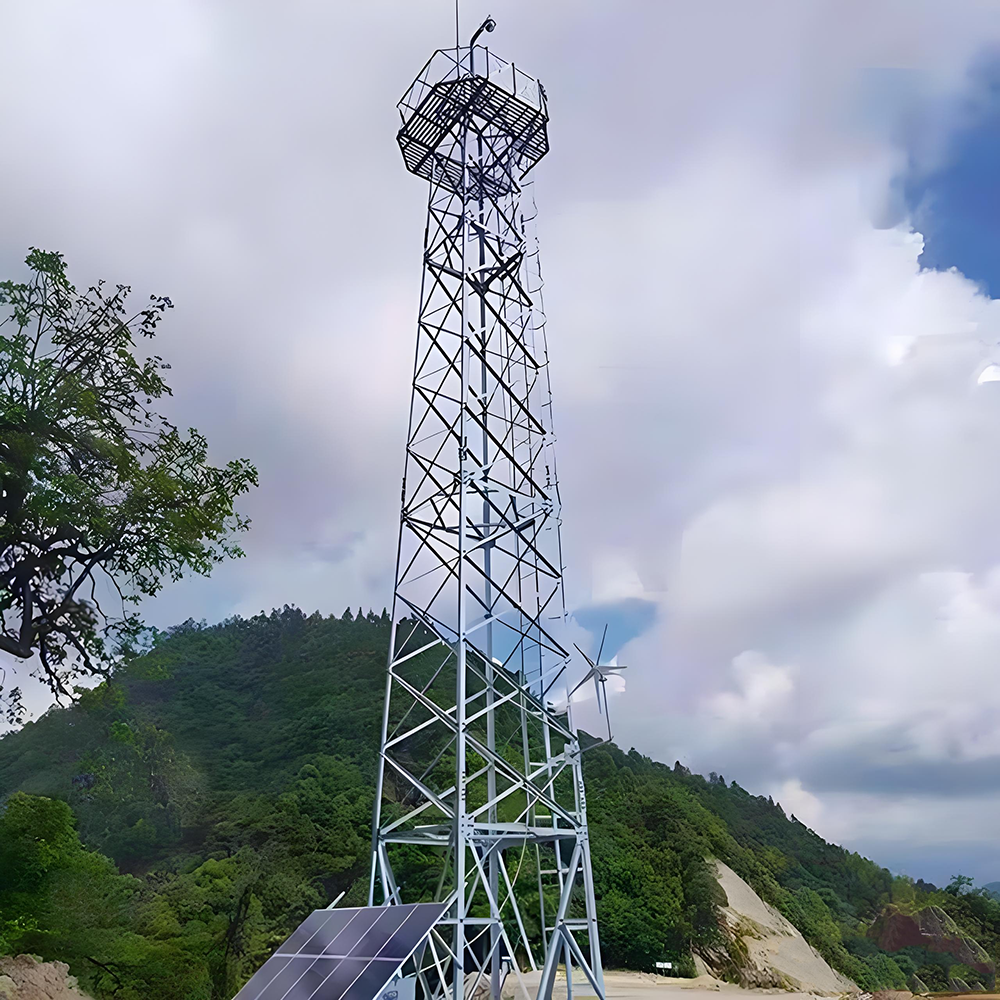
Telecom infrastructure relies on three main structural families to carry antennas: the lattice tower, the monopole, and the guyed mast. The differences between them go well beyond appearance—they involve fundamentally different load paths, land requirements, installation schedules, and lifecycle costs. Which one fits a given site depends on site conditions, load demand, and height targets, not on price comparison alone.

1. The lattice tower: built for capacity and co-location
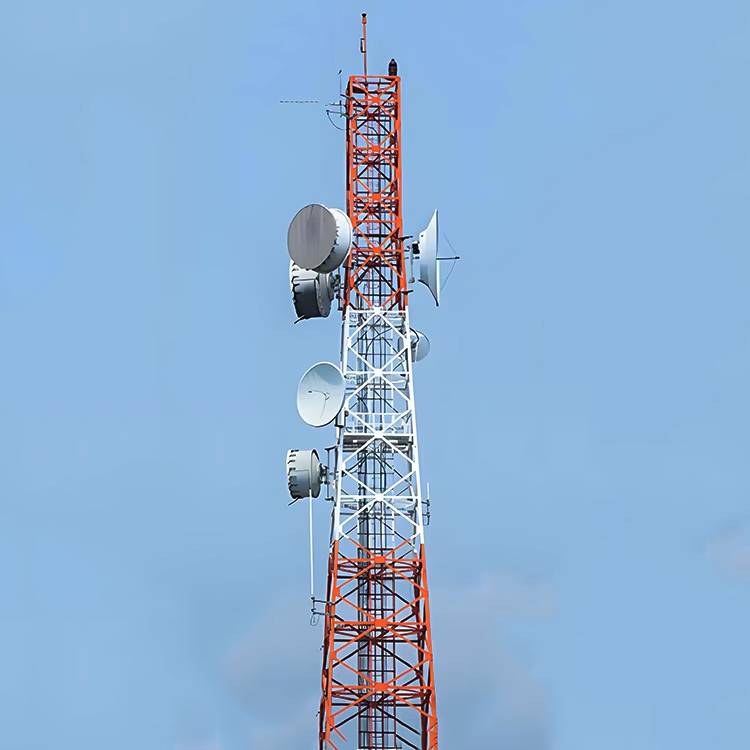
A lattice tower is a space truss of hot-dip galvanized angle steel, bolted together and supported on four legs. Its strengths are load capacity and structural stiffness. Because the open framing is permeable to wind, the load acting on the structure is comparatively modest relative to its projected area; top deflection and twist are easier to control, which supports microwave dish alignment; and the structure can carry multiple antenna arrays while accommodating several operators on one tower. There is also more room for adding antennas or reinforcing the structure later. The trade-offs are four separate footings and a larger land footprint, a high piece count, bolted assembly on site that takes longer, and shipment in knocked-down parts. Typical heights run about 30–100 m, and the type shows its structural advantages most clearly on heavy-load, tall, and multi-tenant sites.
2. The monopole: a practical answer for constrained sites
A monopole is built around a single tapered tubular steel shaft, spliced by slip joints or flanges. It needs one small foundation, presents a clean appearance, and can be dressed with camouflage or decorative shrouds—which is why it is widely used in cities, along roads, and on land-limited sites. Installation is usually a matter of lifting sections into place, so schedules are shorter. Its limits lie in capacity and height: as a solid-walled section it presents a larger wind area, so steel weight grows quickly with height and antenna loading, and the number of antennas and tenants it can carry is comparatively limited. Typical heights run about 15–50 m, which suits coverage-driven sites with modest antenna configurations.
3. The guyed mast: trading land for steel
A guyed mast combines a slender shaft with guy wires in several directions. The guys share the horizontal load, which reduces steel consumption per metre of height considerably—making this type economical in remote areas and at greater heights. The precondition is space: anchor points must spread outward from the mast, so the ground area involved is clearly larger than for self-supporting structures. That makes guyed masts a good match for mountainous, rural, and open sites. Once in service, guy tension and anchor condition need periodic inspection, so maintenance effort is higher than for self-supporting types. Typical heights run about 30–150 m.
4. Six questions that settle the choice
The decision comes down to six questions: How much land is available? What height is required? What antenna and tenant loads must be carried? What are the lifting and transport conditions? What wind, ice, and corrosion levels apply? And what do local planning and visual requirements allow? Once those answers are fixed, the structure type usually narrows on its own.
5. Shared ground: corrosion protection and design standards
Whichever type is chosen, corrosion protection and design standards set the common baseline. Members and fasteners are normally hot-dip galvanized as assemblies to standards such as ISO 1461 or GB/T 13912, with average coating thickness graded by member thickness—about 45–85 µm—and higher coating classes specified for coastal or industrial environments. Structural design can follow TIA-222, Eurocode 3 (EN 1993-3-1), or national tower and mast codes such as GB 50135, combined with the load provisions applicable to the project location. Slip joints on monopoles and guy anchorages on masts are the weak points for corrosion and deserve dedicated attention in design and acceptance inspection.
Closing
No single structure type suits every site. What works is the type that matches the site's conditions. Gather the site dimensions, antenna loads, target height, wind and ice criteria, and tenant plan into one technical input, and let a manufacturer's engineering team run the selection and load calculations—that approach controls lifecycle cost far better than comparing three tower types on price alone.