
 EN
EN
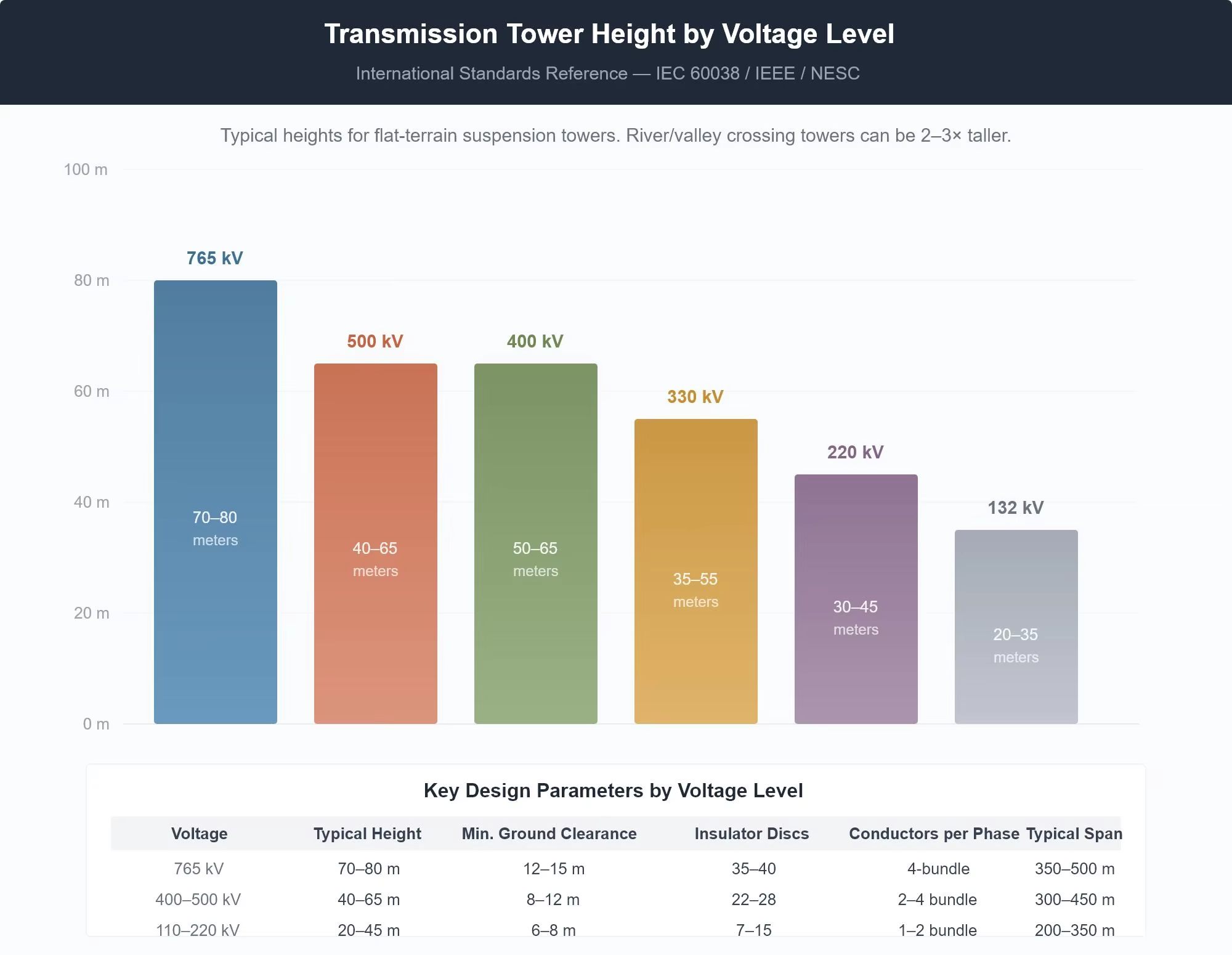
66kV transmission towers are the backbone of regional power grids across Asia, Africa and South America. This buyer's guide covers tower types, steel & galvanizing specs, clearances, pricing and a step-by-step procurement checklist.
A 66kV transmission tower is a steel lattice or monopole structure that supports overhead power lines operating at 66,000 volts. Sitting between distribution networks (33kV and below) and high-voltage transmission (132kV and above), 66kV towers typically stand 15–55 m tall with spans of 300–450 m. They are built from hot-dip galvanized structural steel and designed for a service life of 50 years or more.
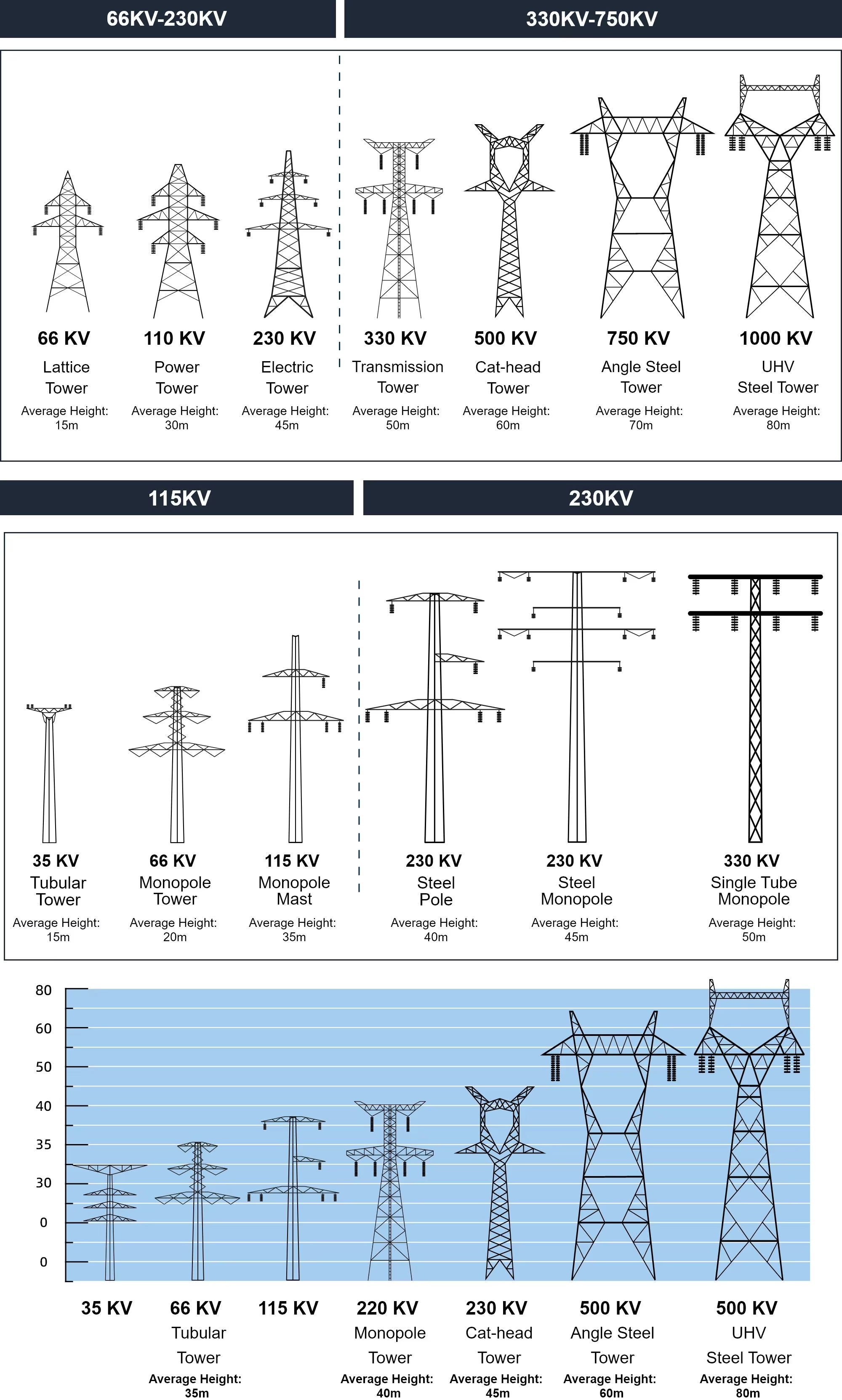
| Specification | 66kV Tower Typical Range |
|---|---|
| Height | 15–55 m |
| Tower weight | 1,000–5,000 kg |
| Span length | 300–450 m |
| Ground clearance | ≥ 6.1 m |
| Main member steel | Q345B / ASTM A572 Gr.50 |
| Zinc coating | ≥ 86 µm (610 g/m²), ASTM A123 |
| Design life | 50 years |
| Insulators | 6 discs per string (11 kV/disc) |
If you are sourcing 66kV towers for a utility project, an industrial grid extension or a renewable energy evacuation line, this guide tells you what to specify, what to check and how to evaluate suppliers before you issue an RFQ.
Why 66kV Is Its Own Voltage Class
The 66kV class is a "sub-transmission" level that balances transmission capacity against infrastructure cost — which is exactly why it remains the workhorse of regional grids in Asia, Africa, the Middle East and parts of South America.
| Parameter | 33kV Tower | 66kV Tower | 132kV Tower |
|---|---|---|---|
| Typical height | 12–25 m | 15–55 m | 25–65 m |
| Span distance | 150–250 m | 300–450 m | 350–500 m |
| Insulators per string | 3 discs | 6 discs | 9–10 discs |
| Tower weight | 800–2,000 kg | 1,000–5,000 kg | 3,000–10,000 kg |
| Main member steel | Q235B | Q345B | Q345B / Q420B |
| Ground clearance | ≥ 5.5 m | ≥ 6.1 m | ≥ 6.7 m |
For a regional utility, 66kV delivers nearly the capacity of higher voltage classes at a fraction of the substation and ROW (right-of-way) cost — while remaining far more robust than a 33kV distribution network. That is why 66kV projects keep coming back to our factory in Hebei, which has manufactured transmission structures for more than 50 countries since 1994.
Types of 66kV Transmission Towers
Not every tower on a line does the same job. The type is decided by its position on the route and the mechanical loads it must carry.
Suspension Towers (Tangent / Intermediate)
Suspension towers support conductors on straight-line sections through suspension clamps. They carry vertical loads from conductor weight and ice, but very little longitudinal load.
- Make up roughly 80–85% of all towers on a typical line
- Lightest and most economical per tower
- Fastest to fabricate and erect
Tension Towers (Strain Towers)
Tension towers anchor conductors at direction changes, long crossings and line terminations, using strain insulator strings instead of suspension clamps.
Typical locations:
- Where the line changes direction by more than 2°
- River or valley crossings with long spans
- Before and after substation entry points
- Every 3–5 km as dead-end sections to limit fault damage
Angle Towers
Angle towers handle horizontal deviations in the route and are classified by the angle they can carry:
| Angle category | Deviation range | Typical application |
|---|---|---|
| Light angle | 0–15° | Minor route adjustments |
| Medium angle | 15–30° | Moderate direction changes |
| Heavy angle | 30–60° | Major route corners |
| Dead-end | 60–90° | Right-angle turns, terminations |
Terminal Towers
Terminal towers connect the overhead line to a substation or cable transition. Because conductors only approach from one side, they must resist unbalanced longitudinal loads — making them among the heaviest members on the route.
Transposition Towers
On lines longer than roughly 100 km, transposition towers swap conductor phase positions every 30–50 km to balance electrical characteristics. They are specialized structures requiring careful detailing — a good test of a fabricator's engineering depth.
Key Technical Specifications
Structural Steel
| Component | Steel grade | International equivalent | Min. yield strength |
|---|---|---|---|
| Tower legs / main members | Q345B | ASTM A572 Gr.50 / S355JR | ≥ 345 MPa |
| Bracing / secondary members | Q235B | ASTM A36 / S235JR | ≥ 235 MPa |
| Heavy-duty members | Q420B | ASTM A572 Gr.65 | ≥ 420 MPa |
Every steel batch should be verified against its mill certificate — chemical composition and mechanical properties — before fabrication. At our Hengshui plant, incoming steel is tested batch by batch, and the traceability record follows the material from the warehouse to the finished member.
Hot-Dip Galvanizing
Zinc coating thickness is the single biggest factor in tower longevity. Specify it by environment, not by default:
| Environment | Minimum zinc coating | ASTM A123 class |
|---|---|---|
| Normal / rural | 86 µm (610 g/m²) | Grade 65 |
| Industrial | 100 µm (700 g/m²) | Grade 85 |
| Coastal / marine | 140 µm (1,000 g/m²) | Grade 100 |
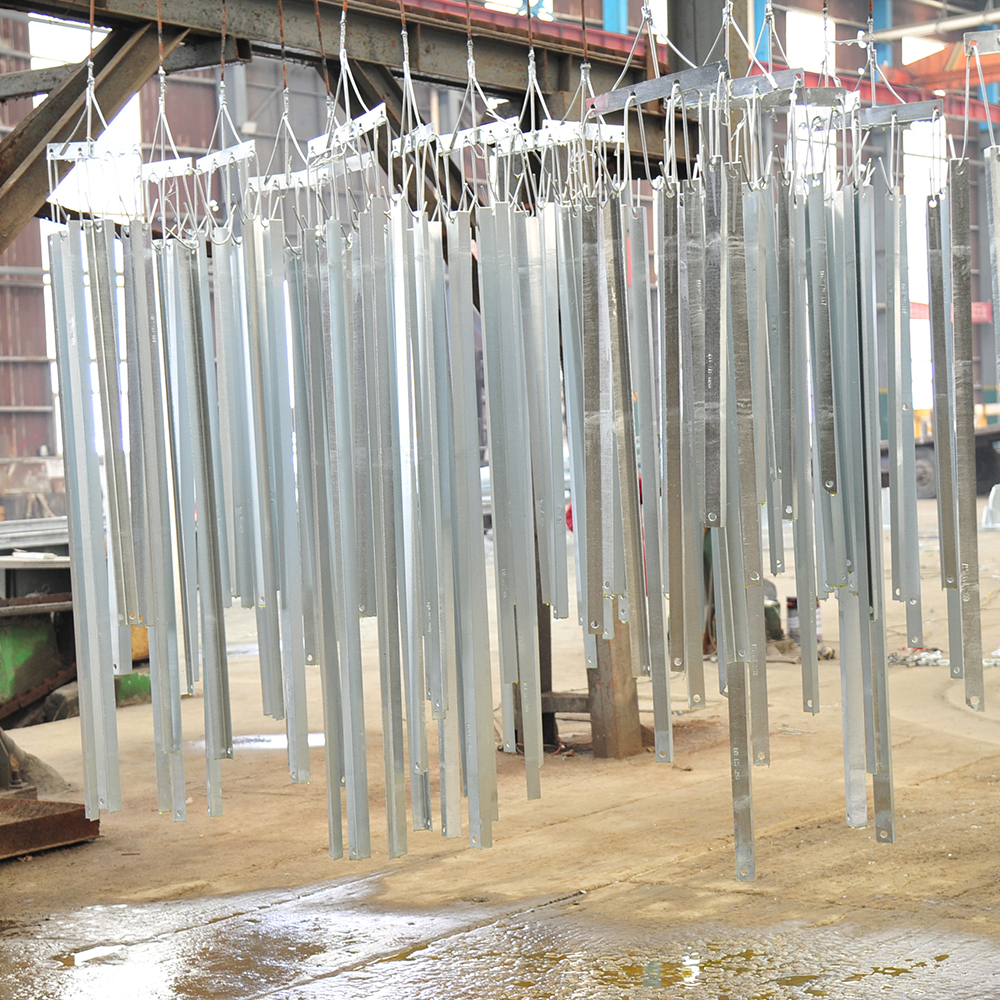
Xinyuan operates its own hot-dip galvanizing plant — 60,000 m² with a designed annual capacity of 300,000 tons — so coating thickness, adhesion and coverage are controlled in-house, not outsourced. The plant is equipped with sewage recycling, waste-acid treatment and zinc-smoke/acid-fog controls, so quality and environmental compliance go together.
Electrical Clearances (per IEC 60826 and national grid codes)
| Clearance type | Minimum distance |
|---|---|
| Ground (normal terrain) | 6.1 m |
| Ground (cultivated land) | 7.0 m |
| Road crossing | 7.5 m |
| Railway crossing | 8.5 m |
| Building proximity (horizontal) | 4.0 m |
| Phase-to-phase | 1.2 m |
Insulator Configuration
66kV lines use disc-type suspension insulators rated at 11 kV per disc; a normal string carries 6 discs, with the count rising with pollution level:
| Pollution level | Creepage distance | Disc count |
|---|---|---|
| Light | 16 mm/kV | 5–6 |
| Medium | 20 mm/kV | 6–7 |
| Heavy | 25 mm/kV | 7–8 |
| Very heavy | 31–45 mm/kV | 8–10 |
Design and Manufacturing Standards to Verify
Design standards: IEC 60826 (loading & strength), ASCE 74, GB 50545-2010, DL/T 5154-2012, EN 50341.
Manufacturing standards: ISO 9001:2015 (quality system), GB/T 2694-2018 (tower fabrication), ASTM A123 / ISO 1461 (galvanizing), AWS D1.1 (welding), ASTM A394 / ISO 898 (bolts).
Xinyuan is certified to ISO 9001, and every order is supported by full documentation: loading calculations, fabrication drawings, galvanizing reports, steel mill certificates, bolt torque specs and erection drawings. Third-party inspectors (SGS, BV, TÜV) are welcome at our factory — most of our export orders are shipped with independent inspection.
Lattice Tower or Monopole?
For 66kV, lattice towers dominate on cost — but monopoles win where space and appearance matter.
| Factor | Lattice tower | Monopole |
|---|---|---|
| Cost per tower | $3,000–8,000 | $5,000–15,000 |
| Weight | 1,000–5,000 kg | 2,000–6,000 kg |
| Foundation | Larger (4 legs) | Smaller (single base) |
| ROW width | 15–25 m | 5–10 m |
| Erection time | 3–5 days | 1–2 days |
| Visual impact | Higher | Lower |
| Best fit | Rural, open terrain | Urban, restricted corridors |
Choose lattice when cost per km matters and terrain is open. Choose monopole when ROW is tight, appearance is a concern, or fast erection justifies the premium.
Foundation Requirements by Soil Type
Foundations typically account for 15–25% of total installed cost — so a geotechnical survey before design is not optional.
| Soil type | Foundation type | Typical depth | Concrete grade |
|---|---|---|---|
| Normal soil | Pad / spread footing | 2.0–3.5 m | M20–M25 |
| Soft soil | Raft foundation | 1.5–2.5 m | M25–M30 |
| Rock | Rock anchor | 1.0–2.0 m | M25 |
| Waterlogged | Pile foundation | 6–15 m | M30–M35 |
| Sandy / loose | Drilled shaft | 4–8 m | M25–M30 |
What Drives 66kV Tower Pricing
Typical 66kV tower pricing runs $800–1,400 per ton. The main variables:
- Steel prices — raw material is 60–70% of tower cost, and Q345B tracks global commodity markets
- Design complexity — angle and terminal towers run 30–50% more than suspension towers
- Galvanizing spec — coastal 140 µm coating adds 15–20% over standard 86 µm
- Order volume — orders above 500 tons typically achieve 8–12% better unit pricing
- Delivery terms — FOB vs. CIF, inland haulage and port handling all affect landed cost
With a tower production capacity of more than 70,000 tons per year plus in-house galvanizing, we can hold competitive pricing on projects from 50 tons to 5,000+ tons — and we have delivered against those schedules on projects across Africa, Southeast Asia and Latin America.
Procurement Checklist for 66kV Towers
Project information to prepare before RFQ:
- Voltage class and circuit configuration (single or double circuit)
- Total line length and estimated tower count
- Terrain profile (flat, hilly, mountainous)
- Environmental loads (wind zone, ice loading, pollution level)
- Applicable national standards
Supplier qualification to verify:
- ISO 9001:2015 certification
- Type test certificates per IEC 60652
- Reference projects with comparable specs
- Acceptance of third-party inspection (SGS, BV, TÜV)
- Verifiable production capacity
Documentation to request:
- Loading calculations
- Foundation design drawings
- Galvanizing test reports
- Steel mill certificates (MTCs)
- Bolt torque specifications
- Assembly and erection drawings
Installation Timeline Expectations
| Phase | Duration | Activities |
|---|---|---|
| Engineering | 4–8 weeks | Survey, tower design, foundation design |
| Fabrication | 6–10 weeks | Cutting, welding, galvanizing, packing |
| Shipping | 4–8 weeks | Ocean freight to destination |
| Foundation | 2–3 weeks per tower | Excavation, rebar, concrete |
| Erection | 3–5 days per tower | Assembly, bolt torque, alignment |
| Stringing | 1–2 days per span | Conductor installation, sag-tension |
A 100-tower project typically runs 8–12 months from contract signing to energization.
FAQ
How tall is a 66kV transmission tower? Typically 15–55 m. Suspension towers average 18–25 m, tension towers 30–45 m; river crossings or mountainous terrain can push heights toward 55 m.
How much does a 66kV tower weigh? 1,000–5,000 kg depending on type and height. Suspension towers average 1,200–2,500 kg; tension and angle towers run 2,500–5,000 kg. Double-circuit designs add roughly 40–60% more weight.
How far apart are 66kV towers spaced? 300–450 m in normal terrain — up to 450 m on flat ground, 250–350 m in hilly terrain, and 600–800 m on special river/valley crossings.
What steel is used for 66kV towers? Q345B (≈ ASTM A572 Gr.50) for main members, Q235B for bracing, all hot-dip galvanized to a minimum of 86 µm per ASTM A123.
How long does a 66kV tower last? Design life is 50 years; in clean rural environments with routine maintenance, towers can serve 70+ years. Heavy industrial or coastal pollution may reduce effective life to 35–40 years unless coating is upgraded.
Get 66kV Tower Specifications for Your Project
Xinyuan Iron Tower Group has manufactured transmission, communication and substation structures since 1994 from our factory in Hengshui, Hebei — 120,000 m² of workshop space, 695 employees, and an annual tower output of more than 70,000 tons, exported to over 50 countries.
For 66kV tower specifications, pricing or technical consultation, contact us at Electricaltower.com with your project details — our engineering team typically responds within 24 hours with preliminary recommendations.
Table of Contents
- Why 66kV Is Its Own Voltage Class
- Types of 66kV Transmission Towers
- Key Technical Specifications
- Design and Manufacturing Standards to Verify
- Lattice Tower or Monopole?
- Foundation Requirements by Soil Type
- What Drives 66kV Tower Pricing
- Procurement Checklist for 66kV Towers
- Installation Timeline Expectations
- FAQ
- Get 66kV Tower Specifications for Your Project