
 EN
Many clients walk into our workshop, see the piles of angle steel members and the full set of fabrication drawings, and ask the same question: isn't building a steel tower just a matter of cutting, drilling, galvanizing and assembling the pieces according to the drawings?
On the surface, yes. Manufacturing an angle steel tower is essentially a process of turning drawings into physical members: detailing, cutting, drilling, assembling, hot-dip galvanizing and pre-assembly testing, each step following the drawing. But what we want to make clear is that a reliable angle steel tower is never a simple copy of a drawing. What really determines whether a tower performs well is whether the design phase treated the actual transmission line site as the first priority, rather than merely working out the theoretical figures on paper.
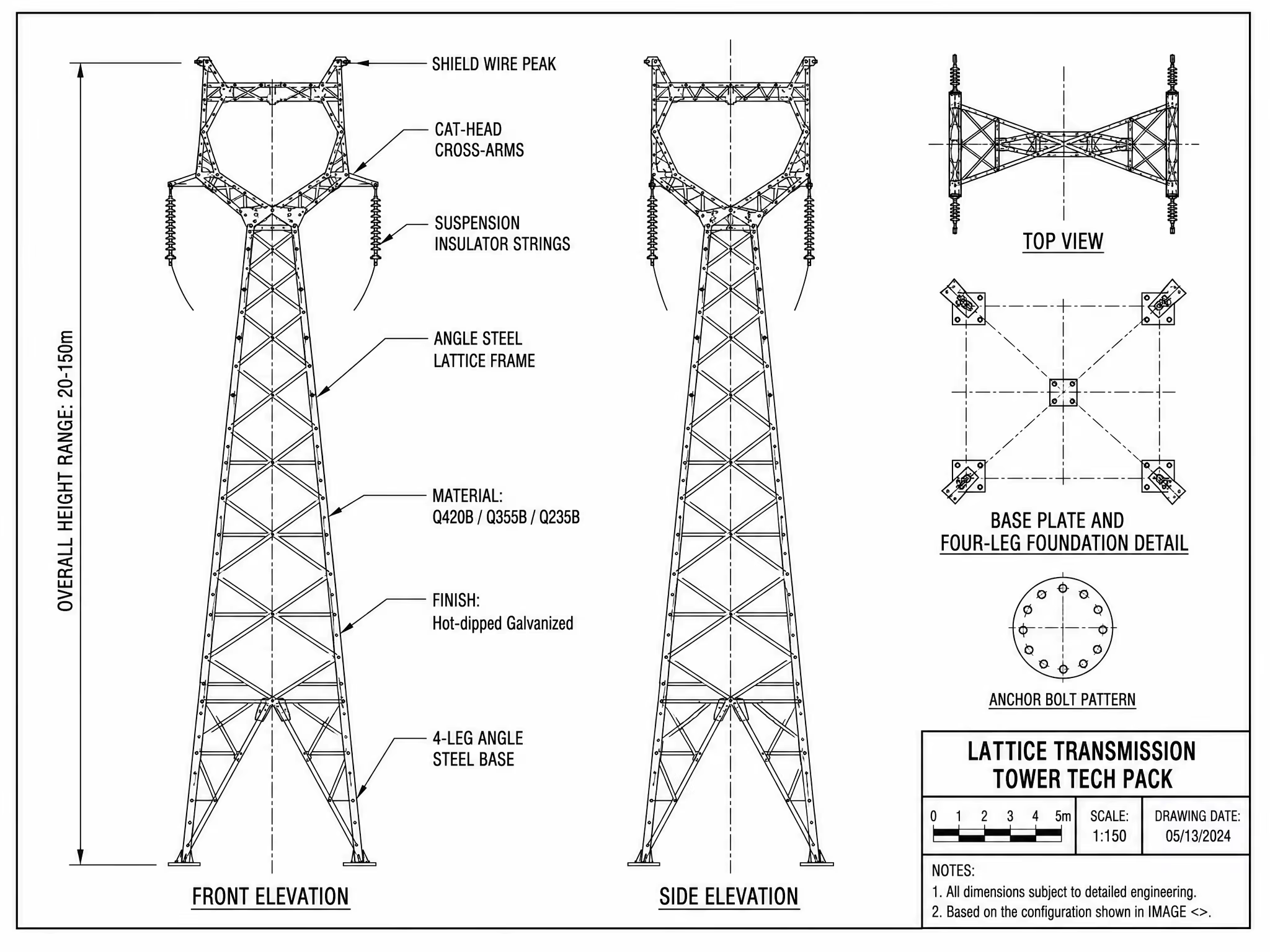
Drawings lay the foundation, but they are not the whole story. In engineering, drawings answer the question "what the members look like and what dimensions they have." The line site answers a more demanding question: "what loads this tower must bear, what environment it will face, and how it can stand safely on the ground." Between the two there is a great deal of engineering judgment. Focusing only on the drawings can produce members that look perfect on paper but fail under real site conditions.
Let us start with loading. A transmission angle steel tower carries far more than the weight of conductors and its own structure. Wind load is the most critical factor, and it changes with wind direction, wind speed and terrain. Coastal areas face typhoons and salt spray; high-altitude mountainous regions face strong winds and ice accumulation; plains must cope with conductor tension changes caused by temperature variation. If the same drawings are applied to different lines, the force distribution on each part of the tower can differ greatly. If these working conditions are not calculated one by one, and generic parameters are used instead, even thicker steel members may not be placed where strength is actually needed.
Then there is line routing and angle points. A transmission line rarely runs in one straight line. There are angle points, crossings and changes in span length. Angle towers must withstand the unbalanced tension of conductors, terminal towers take the lateral pull from the whole line section, and tangent towers cope with elevation changes along the terrain. The member layout, main member sizes, bracing directions and connection plate positions all need to correspond to these specific conditions. The design logic of an angle steel tower is to combine different specifications of angle steel so that every main member, bracing member and connection plate does its job and transfers loads safely to the base and foundation.
Foundation and terrain adaptation also matter. Tower positions often sit on complex ground: some on slopes where the four tower legs are at different elevations, some on soft or high-water-table soil, some on rock. During design, these site conditions need to be considered to decide the tower leg slope, extension method and matching foundation type. A design truly made for the line has already accounted for these field factors before any drawing is issued, rather than leaving them to be worked out roughly on site.
Drawings fix the design intent; manufacturing turns it into reality. In our workshop, angle steel tower fabrication follows a strict process. First comes detailing: we break down the structural drawings into individual members with marked dimensions, hole positions, material grades and quantities, forming a member schedule. Detailing accuracy directly determines the quality of downstream processing and whether the whole tower can be assembled smoothly.
For cutting and drilling, we use CNC equipment, and hole positions and dimensions are strictly controlled according to the drawings to ensure each member matches its neighbors. Angle steel towers are characterized by a large number of members and complex connections. If hole spacing on members deviates, the problem will show up during on-site trial assembly, and rework costs can be high. That is why we move accuracy control forward to the fabrication stage, solving problems inside the workshop whenever possible.

Hot-dip galvanizing comes next. It is the key to long service life outdoors. A steel tower must withstand decades of wind, rain, sunlight and salt in the field. Bare steel alone does not have enough corrosion resistance, so hot-dip galvanizing applies a dense zinc coating to the surface to provide protection. Before galvanizing, we degrease, pickle and flux the members to ensure the zinc layer bonds firmly and covers evenly. Coating thickness is controlled according to project requirements, extending service life in complex outdoor environments and reducing maintenance and touch-up work later.
Pre-assembly is the final check before shipping. We trial-assemble the whole tower according to the drawings, checking hole matching, dimension fit and overall stability, then disassemble, pack and dispatch once confirmed. The purpose is to detect and solve assembly problems inside the factory as much as possible, so that members erect smoothly on site.
At the core of all this is a simple point: drafting is a basic capability, but truly building the line site into the design is where tower reliability comes from. We connect design, fabrication, galvanizing and inspection into one complete chain, with every step driven by what the line actually needs, rather than only by figures on drawings.
If you have transmission tower project requirements, whether it is angle steel tower selection, drawing design, or member fabrication, we welcome you to get in touch. Based on your specific line conditions, voltage class and site situation, we can work together on a solution so that every tower truly serves the line it is built for.
——A field record from the Xinyuan Tower factory