
 EN
The Member Schedule Is the Real Contract Document
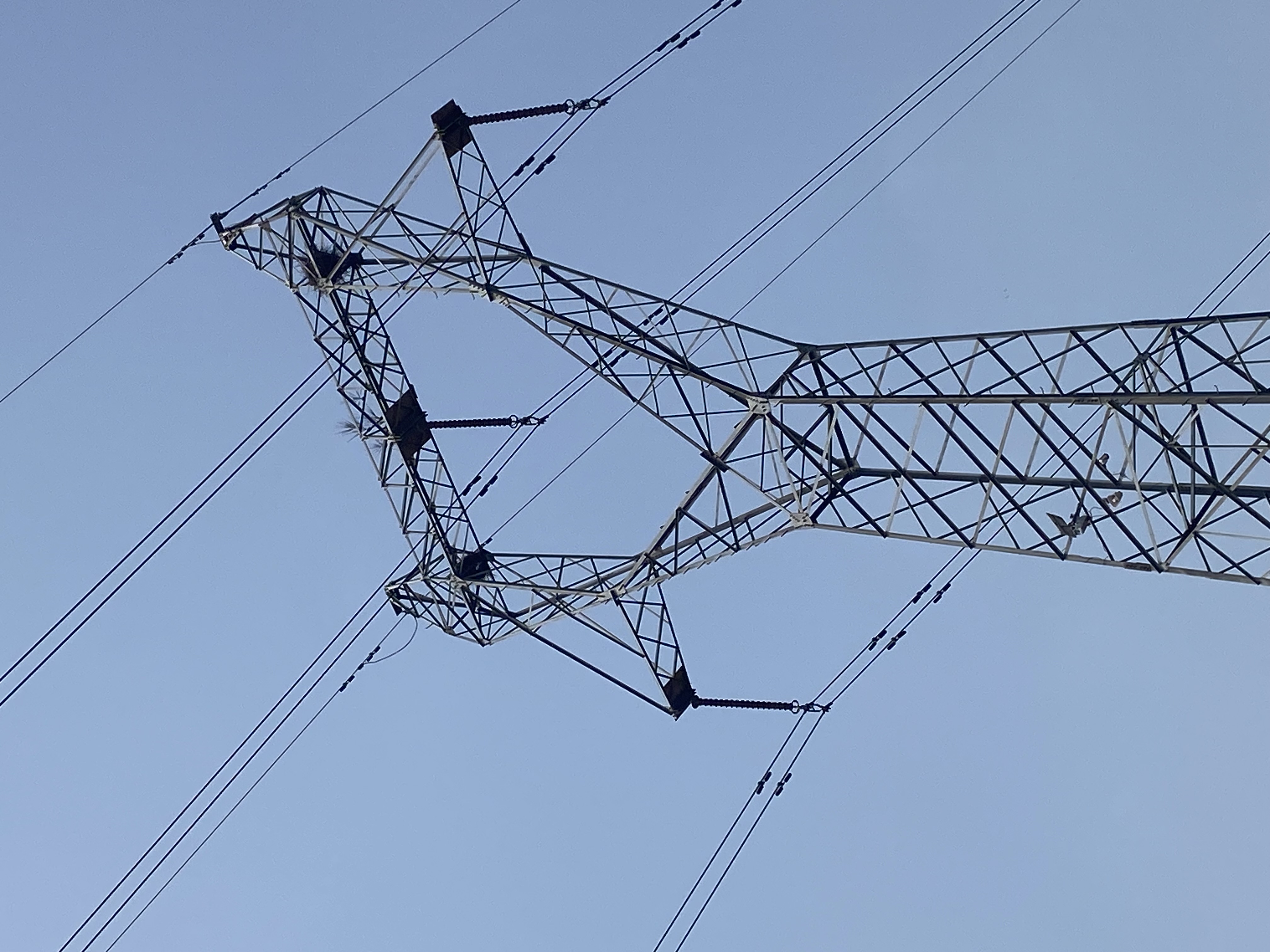
The general arrangement drawing tells a line engineer what the tower looks like. The member schedule tells the fabricator and the erection crew what it actually is.
A complete schedule carries, for every member mark: the angle section, cut length, hole pattern and gauge, bolt diameter and count, steel grade, galvanizing requirement and unit weight. Two details separate a workable schedule from a troublesome one.
A marking system that survives galvanizing. Marks stamped or punched before hot-dip galvanizing remain readable after coating only where indentation depth and location are specified. Paint markings do not survive the zinc kettle.
A numbering hierarchy that matches how crews read the tower. Legs, plan bracings, face diagonals and redundant members should not share one numbering block. On a 60-metre tower, a fitter reads a mark through a telescope or by touch at height. Grouping marks by Reading the Schedule the Way a Site Engineer Does
Three columns in the schedule deserve more attention than they usually receive.
Length versus hole-to-hole dimension. The cut length includes end distances; the hole-to-hole dimension governs whether the panel closes. On long diagonals, a 3 mm error at each end becomes a 6 mm mismatch at the joint, which is enough to stop a bolt entering.
Bolt diameter grouped by joint, not by member. A common cause of delay is a schedule that lists bolt sizes per member, forcing crews to sort hardware by joint in the air. Bolts sorted and bagged per joint — or per panel — at the factory remove that step.
Redundant members listed separately. Secondary bracing carries little load but consumes a large share of erection time. Separating it in the schedule and in the packing list allows a crew to pre-assemble panels on the ground with all secondary members already in place.
Fabrication Discipline That Prevents Field Problems
Angle towers are bolted structures; welding is largely confined to leg splices, flange connections and special details. This concentrates quality risk in four operations.
Cutting and punching. CNC saw-and-drill lines hold hole position to within roughly ±1.5 mm and hole diameter to +1/−0 mm. Holes are punched or drilled to final size; field reaming to make a connection fit is a symptom of a fabrication problem, not a solution to it.
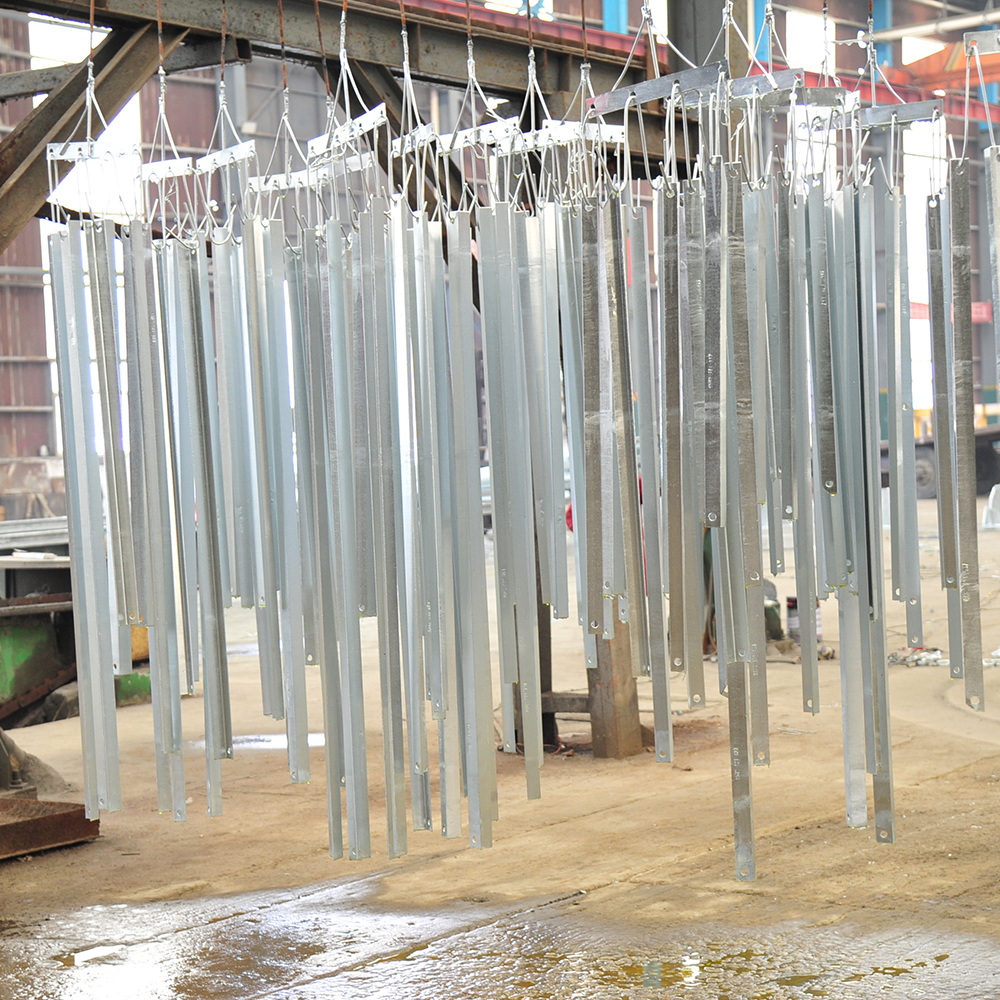
Straightening after galvanizing. Hot-dip galvanizing at 445–460 °C relieves rolling residual stress and can bow long, slender members. Straightening limits and the method — cold versus controlled heat — must be stated in the purchase specification, otherwise members arrive with sweep that shows up as a visible kink in the finished face.
Coating control. Under ISO 1461, steel 6 mm and above requires a minimum average coating of 85 µm with a 70 µm local minimum; thinner sections carry lower thresholds. Under ASTM A123 the values are expressed in the same order of magnitude for equivalent thickness ranges. Coating thickness is measured on the finished member, not assumed from dipping time.
Drain and vent provision. Hollow sections, overlapped plates and closed details need drain holes so that pickling liquid and rinse water leave the part and zinc can coat the interior. Missing drain holes produce weeping joints and premature coating failure months after energization.
Trial Assembly: The Test That Costs Least
A trial assembly of one leg section, or of the most heavily connected panel, before shipment resolves interference, hole mismatch and marking errors at the factory, where correction costs hours rather than weeks.
The output of trial assembly is not a photograph. It is a signed record listing every connection checked, every deviation found, the corrective action and the revised revision number. That record travels with the shipment.
Packing and Marking: The Logistics of Three Thousand Pieces
Packing determines how fast the tower goes up. Three rules cover most of it.
Pack by erection sequence, not by member size. Bundles should arrive in the order the crew needs them: stub angles and first leg extensions first, cap plate and fittings last.
Pack bolts with the members that use them. A joint-level bolt bag attached to the bundle it belongs to eliminates the site hardware store, and with it the most common cause of idle crane time.
Mark both ends of every bundle. A bundle identified at one end only will be opened at the wrong end of the laydown yard at least once.
Shipping damage is worth designing against: banding without timber spacers crushes angle toes, and stacking heavy leg bundles on top of slender bracing produces bent members that are straightened on site by whatever is available.
The Foundation Interface: Where Projects Lose Weeks
The tower schedule assumes a foundation that meets its own tolerances. In practice, the gap between the two documents is where programmes slip.
Before the first steel is lifted, verify: stub angle spacing in both directions, stub top elevation across all four legs, stub uprightness, bolt projection above the stub top, bolt thread condition, and the anchor bolt grade against the drawing. Grout pads and shims are prepared in advance — never improvised from scrap plate after the leg is already hanging.
The stub-to-leg connection is a single bolted interface carrying the entire leg load. A stub that is out of position by more than the drawing allowance cannot be corrected by slotting the tower's base plate.
Choosing the Erection Method
Three methods cover most lattice tower construction, and the choice is driven by access, tower height and crane availability rather than preference.
Whichever method is used, the sequence follows the schedule: legs and plan bracing form the stable base, face diagonals close the panels, redundant members follow, and the earthwire peak is erected last with its own lifting arrangement.
Temporary guys, if used, are designed — not improvised from available rope. Their anchor points are checked as part of the lift plan.
Bolted Connections: Torque, Turn-of-Nut and Galvanized Reality
Tower bolts are typically galvanized, hot-forged fasteners to ASTM A394 or the project-specified equivalent. Three practical points matter on site.
Snug tight, then final tension. The connection is brought to snug tight, alignment is verified, and final tensioning follows. Torque applied to an out-of-line connection loads the bolt in bending rather than tension.
Calibrate the wrench, do not trust the setting. Torque values are established by calibration against the actual bolt lot, with the actual coating and lubrication condition, on a tension-calibrating device. Published tables assume ideal friction; galvanized threads with dry or weathered lubricant do not match them.
Turn-of-nut where torque is unreliable. For larger diameters and heavily coated fasteners, the turn-of-nut method after snug tight is more repeatable than a torque wrench. The specified rotation — typically one-third to one-half turn depending on grip length and surface condition — is marked on the nut and bolt before turning so that the audit is visual.
Two field habits are worth prohibiting outright: using a drift pin to enlarge a hole, and substituting a higher-grade bolt to force a misaligned joint closed.
Plumb, Alignment and the Shimming Question
Verticality is specified against tower height — commonly in the range of H/500 to H/1500 depending on tower height, line class and client standard, and always confirmed against the project specification rather than assumed.
Measurement is taken on the leg faces, in two orthogonal directions, at defined heights, with the readings recorded rather than remembered. Measurement during erection, at each completed panel, is far cheaper than measurement after the conductors are strung.
Shimming at the base is permitted only within the allowance stated on the foundation drawing, using the specified material, with the shim pack recorded. A tower levelled by stacking plate under two legs and leaving the other two bearing on grout is a tower with an unrecorded load path.
Fitting Installation: The Last Twenty Percent That Decides Performance
Erection completes the structure. Fitting installation decides whether the line performs.
Insulator strings and hardware. Suspension and tension sets are assembled on the ground, checked against the hardware drawing, and lifted with slings that do not bear on sheds or on the porcelain-to-cap cement joint. Corona and grading rings are positioned per drawing — a ring installed upside down is a radio interference complaint six months later.
Conductor protection hardware. Armour rods are applied with the correct lay direction and end gap; vibration dampers are positioned at the calculated distance from the clamp, measured, not estimated by eye. Damper position errors show up as conductor fatigue, not as an installation defect.
Spacers and bundle hardware. Sub-conductor spacing, spacer positions and the specified torque on spacer bolts are recorded. Overtightened spacer bolts crack the conductor.
Earthing. Each leg is bonded to the earthing system, and the connection is made before backfilling so that resistance can be measured. A resistance reading taken after backfill and recorded as a number in a report is not a measurement.
Safety and marking fittings. Step bolts, ladders, rest platforms, anti-climbing devices, phase plates, number plates, aviation obstruction lights and bird-deterrent devices are checked against the fitting schedule item by item. Missing step bolts are discovered by the maintenance crew, at height, at the worst possible moment.
What Handover Actually Requires
The handover package that protects both the fabricator and the contractor contains: mill certificates traceable to member marks, galvanizing thickness records, the trial assembly report, bolt calibration records, a torque audit sample with locations, the verticality survey, earthing resistance measurements, and as-built mark-ups of any deviation approved on site.
Where a member was replaced, straightened, re-galvanized in the field or a hole was repaired with an approved method, that record belongs in the same package.
Failure Modes Worth Memorizing
Most field failures in angle tower work fall into a short list.
- Members that fit on the ground and not at height, traced to hole-to-hole dimensions rather than cut lengths.
- Coating damaged during transport because bundles were not separated with timber.
- Bolts tightened to a table value for a different lot and coating condition, verified by no record.
- Tower plumb measured once, at completion, after stringing.
- Damper or spacer positions set by eye, discovered as conductor damage in year three.
- Earthing resistance never measured, backfilled, and accepted on the basis of a drawing.
Each of these is prevented by a document, not by more effort.
The Point of the Exercise
An angle tower is a simple structure made difficult by coordination. The steel is straightforward; the joints, tolerances and sequences that connect a member schedule to a standing tower are not.
The projects that finish on programme are the ones where the schedule, the packing list and the erection sequence are written by people who have stood at the base of the tower and looked up.
If your project involves tower heights, terrain or connection details outside the standard range, the useful conversation happens before fabrication — not after the first bundle is opened.
Table of Contents
- The Member Schedule Is the Real Contract Document
- Fabrication Discipline That Prevents Field Problems
- Trial Assembly: The Test That Costs Least
- Packing and Marking: The Logistics of Three Thousand Pieces
- The Foundation Interface: Where Projects Lose Weeks
- Choosing the Erection Method
- Bolted Connections: Torque, Turn-of-Nut and Galvanized Reality
- Plumb, Alignment and the Shimming Question
- Fitting Installation: The Last Twenty Percent That Decides Performance
- What Handover Actually Requires
- Failure Modes Worth Memorizing
- The Point of the Exercise